Craft vs commercial

Craft cannabis vs commercial cannabis comes down to what the process protects.

The difference between craft cannabis and commercial cannabis usually starts with batch scale, handling pressure, and how much patience the process can still afford once the flower is nearly finished. Craft cannabis usually points toward smaller batches, closer handling, and more finish-sensitive production. Commercial cannabis usually points toward scale, standardization, and broader throughput. Those labels matter, but they are not final verdicts. Size alone does not decide quality. What matters is what the system keeps rushing and what it keeps protecting.

Craft is not better because it is smaller. It is better when the smaller scale is actually used to protect decisions larger systems tend to spend casually, especially near harvest, drying, and cure.

What craft optimizes for Handling discipline, expressive finish, and smaller batches where quality signals stay easier to protect.
What commercial optimizes for Consistency, throughput, broad availability, and systems designed to scale without collapsing.
What really decides quality How harvest, drying, cure, and handling were treated once the flower stopped being a plan and became a product.
Simple definitions

Craft usually describes flower produced with more direct human attention. Commercial usually describes flower produced under stronger pressure to scale.

That is the useful starting point, not the full answer. Craft tends to suggest smaller runs, more deliberate handling, slower finish decisions, and a product identity tied to expression. Commercial tends to suggest larger systems, standardized workflows, repeatability, and broader market coverage.

Neither label settles quality by itself. A craft label can be weak if the process is sloppy. A commercial run can still produce competent flower if the system respects maturity, drying, and cure. The real separation appears in what the process refuses to compromise first.
Field note

Scale is not the verdict. Scale only tells you how hard the process had to work to keep quality from getting spent.

  • What gets protected
  • What gets rushed
  • What still survives the jar
Craft usually protects

More room for handling discipline, selective patience, and a finish that still sounds like the batch instead of the schedule.

  • Closer attention during trimming and handling
  • More room to respect harvest timing instead of forcing calendar speed
  • Drying and cure treated as part of product identity, not just throughput
  • More visible batch character when the producer uses the smaller scale honestly
Commercial usually protects

Broader supply, stronger repeatability, and a system built to move dependable flower through more volume without losing control.

  • Consistency across larger production runs
  • Availability and pricing shaped by scale efficiency
  • Standardized workflows that reduce obvious handling variance
  • More pressure to keep schedules and shelf coverage stable
Where the real differences are

The strongest separation is not aesthetic. It is operational.

Craft systems usually make it easier to keep handling, maturity, and finish quality visible. Commercial systems usually make it easier to keep supply, repeatability, and throughput stable across more volume. That difference affects everything downstream: how much room there is for patience, how much individual flower character gets protected, and how much of the final result is being asked to survive scaling pressure.

The mistake is turning that into a cartoon. Commercial does not automatically mean dead flower. Craft does not automatically mean transcendent flower. It means each model is carrying a different kind of pressure, and those pressures shape the product in ways the label rarely explains honestly.

What usually changes first
  • Handling: smaller runs can usually keep this more visible and deliberate.
  • Drying and cure: larger systems often face more pressure to standardize and move volume through.
  • Expression: craft is more likely to market nuance; commercial is more likely to market reliability.
  • Risk tolerance: throughput systems cannot always afford the same kind of pause that smaller systems can.
Comparison table

The difference becomes easier to trust when the optimization goals are stated plainly.

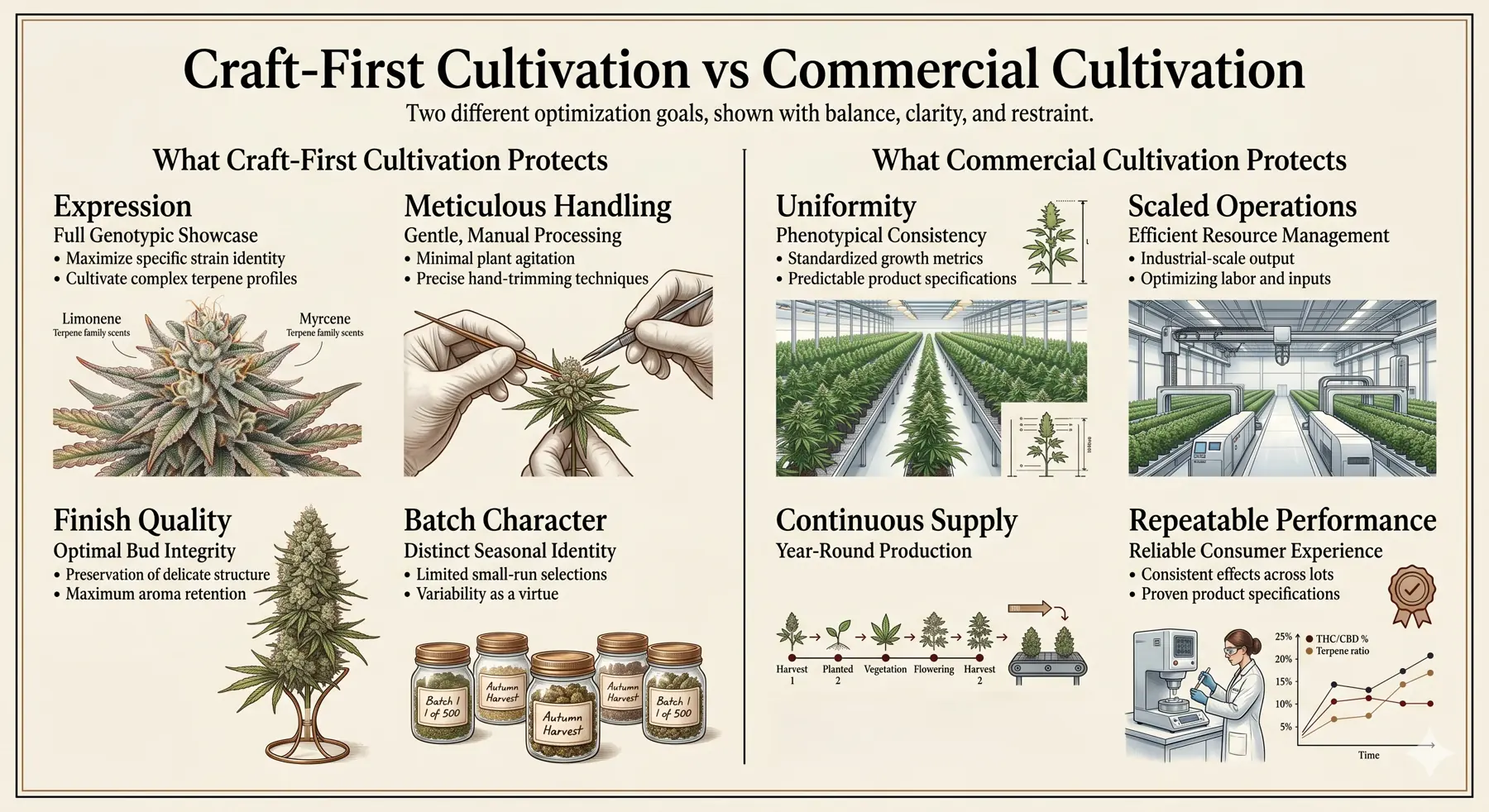
Comparison board showing what craft-first cultivation protects versus what commercial cultivation protects.
The comparison gets easier to trust when the two systems are shown as different protection priorities, not as a cartoon of good versus evil.
Category Craft cannabis Commercial cannabis
Room scale Smaller enough that handling and finish choices stay more visible. Larger systems built to sustain throughput and broad supply.
Handling More likely to preserve batch character and closer attention. More likely to prioritize repeatability across volume.
Trimming More likely to emphasize delicate handling and presentation. More likely to optimize labor and consistency.
Drying More room to protect pace if the producer uses the scale honestly. More pressure to normalize time and output across larger batches.
Harvest timing pressure More likely to leave room for batch-by-batch maturity calls. More likely to keep timing inside larger operational windows.
Curing More likely to be treated as part of the product's character. More likely to be treated as one stage in a larger production pipeline.
Terpene protection Usually marketed as a priority and easier to defend in smaller batches. Can still be good, but more exposed to system-wide compromise.
Batch consistency More variation, but sometimes more character too. More standardized result across more units.
Price logic Often asks the buyer to pay for attention, scarcity, and handling. Often asks the buyer to pay for availability and volume efficiency.
Producer language More likely to talk about batches, finish choices, and handling decisions. More likely to talk about availability, consistency, and broad performance.
Jar behavior When done well, more likely to open with composure and clearer batch identity. Can still be competent, but more exposed to flattening if finish stages were compressed.
What gets optimized Expression, handling, finish quality. Throughput, consistency, shelf coverage.
Where the buyer notices it first Aroma clarity, moisture balance, and how intact the flower still feels once opened. Consistency, accessibility, and whether the flower still feels composed despite scale.
Where quality gets lost When the label outruns the discipline behind it. When throughput starts deciding what maturity and finish should have decided.
Decision layer

Labels only become useful when they help you judge whether the premium was earned or the value was protected.

Earned

When craft earns the premium

The premium starts making sense when the producer can point to slower finish choices, gentler handling, cleaner batch language, and flower that still feels settled when the jar opens.

Value

When commercial is still a reasonable buy

Commercial flower is still a fair value when it arrives clean, stable, properly finished, and honest about what it is: reliable flower built for consistency instead of romance.

Distrust

What should make you suspicious

Be skeptical when the language is all exclusivity and no process, when the only proof is THC, or when the flower sounds more expensive than it sounds well finished.

Where craft gets romanticized

Craft gets oversold the moment smaller scale is treated like automatic proof of care.

A small batch can still be rushed. Hand-trimmed flower can still be badly dried. Premium branding can still wrap flower that never truly settled. This is the part of the conversation the market often skips, because the myth is easier to sell than the process.

Buyers should distrust craft language fastest when the producer cannot explain drying, cure, handling, or batch logic with the same confidence they use to describe exclusivity. ColaXpress leans craft-first, but not blindly. The site only keeps using the word because it can be tied back to room readability, method restraint, honest harvest timing, and finish quality that still makes sense once the lid comes off.

Where commercial gets oversimplified

Commercial flower is not automatically disqualified by size. It is weakened when scale starts spending quality too casually.

Larger systems can still produce competent cannabis. They can still protect consistency, avoid obvious handling mistakes, and deliver usable flower at broader scale. The problem begins when throughput starts making choices that should have belonged to maturity, drying, cure, or product protection.

That is the nuance most comparison pages miss. The question is not whether scale exists. The question is whether the system still knows what it is allowed to rush and what it is not. Commercial becomes more respectable the moment the producer talks clearly about finish discipline instead of hiding behind volume, price, or lab numbers alone.

What to look for

If quality actually matters, the smartest clues are still about handling and finish, not adjectives.

Handle

Handling language

Look for producers who can describe batches, finish, and process choices cleanly instead of relying on lifestyle vocabulary and number flexes.

Finish

Finish quality

Whether the flower was dried and cured properly matters more than whether the label sounded exclusive. A loud jar usually tells the truth faster than marketing does.

Result

What survives

Structure, aroma clarity, moisture balance, and composure in the jar matter more than the size of the claim that arrived with them.

Why the finish matters more than the argument

Most craft-versus-commercial debates become easier once the flower reaches harvest, drying, and cure.

This is where the broader debate stops sounding ideological and starts sounding sensory. Was the flower harvested with maturity in mind? Was the dry controlled instead of hurried? Did the cure settle into clarity, or did the jar stay noisy? Those answers usually matter more than whether the label said craft with enough conviction.

That is why the most honest pages in the ColaXpress system still point forward to harvest ripeness, jar readiness, and curing. The finish is where the argument stops being theoretical.

Why ColaXpress still leans craft-first

ColaXpress leans craft-first because smaller, more readable systems usually make it easier to protect the parts of quality that are easiest to spend.

That is the same logic behind what craft cannabis means, craft cannabis cultivation, and the flagship VGrow DWC guide. The preference is not for smallness as a personality trait. It is for systems where the room, the method, and the finish stay easier to read and harder to fake.

The one-line version

Craft protects expression. Commercial protects throughput. Great flower appears where either system refuses to spend quality casually.