Start with the parts that make the grow readable from day one.
A cabinet or tent, your root-zone system, and the tools to measure pH, EC, and humidity belong in the first purchase wave. Those pieces let you run the grow instead of merely owning one.
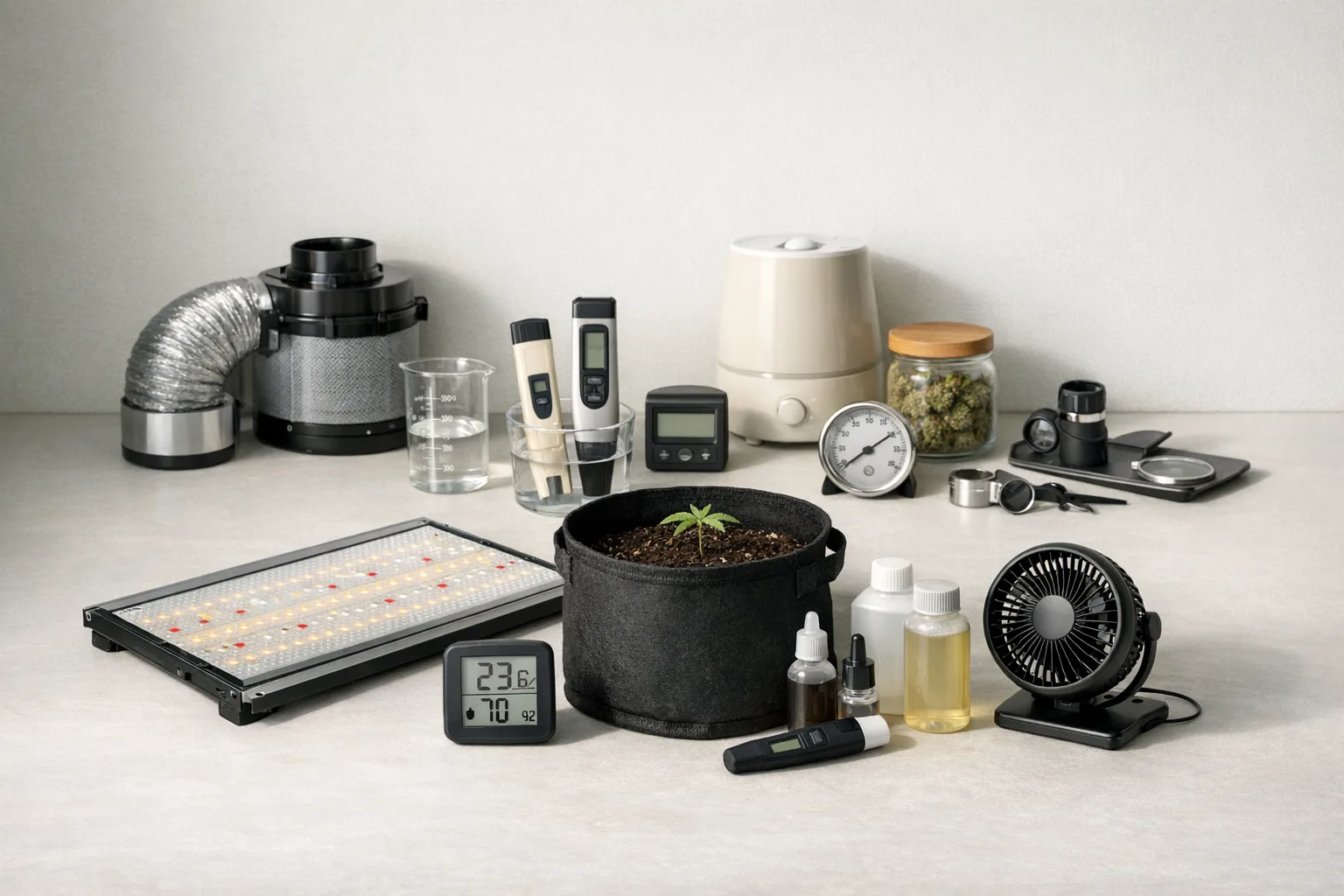
The first purchases for a compact cannabis grow should cover four jobs: contain the environment, support the root zone, measure the important variables, and finish the harvest correctly. Everything else can wait.
Beginners do not usually fail because they own too little gear. They fail because they buy a strange pile of half-solutions and call it preparation.
| Buy stage | What belongs here | Why this timing matters |
|---|---|---|
| First cart | Cabinet or tent, airflow and odor basics, root-zone method, pH and EC tools, humidity read | These make the room readable and the method runnable from day one. |
| Second cart | Replacement basics, extra hygrometer, practical backups, simple drying helpers | These strengthen the workflow after the core setup already exists and proves it deserves support. |
| Before harvest | Loupe or macro tool, jars, cure humidity reads, any missing finish gear | Finish tools bought too late turn the last third of the run into improvisation. |
| Later or only if needed | Convenience upgrades, duplicate readings, cosmetic extras, advanced automation accessories | The grow should ask for these. A nervous cart should not. |
A cabinet or tent, your root-zone system, and the tools to measure pH, EC, and humidity belong in the first purchase wave. Those pieces let you run the grow instead of merely owning one.
The VGrow Smart Box plus DWC kit is the reference setup because it contains the environment and keeps the workflow compact. Then you add only the support gear that helps you read the plant and finish the run cleanly.
Start with the enclosure, airflow, and your chosen root-zone method. Then buy the tools that tell you whether the system is actually behaving: pH, EC, humidity, and temperature reads. If those are missing, the cart is not lean. It is unfinished.
The finish tools still belong in the budget, but they can sit in a later wave as long as that wave happens before harvest starts looking real.
If the cart does not do all three, it is probably too decorative, too optimistic, or too dependent on your future self being more organized than your current one.
Cabinet or tent, light cycle, airflow, and odor control. The room has to exist before the plant does.
DWC kit or comparable method, plus the water and nutrient plan that goes with it.
pH meter, EC meter, hygrometer, and eventually a loupe or macro lens for finish-stage clarity.
Drying support, jars, and humidity tracking. The smoke does not care how pretty the veg stage was.
| Priority | Examples | Why it belongs here |
|---|---|---|
| Required | Cabinet, DWC kit, pH and EC meters, jars, basic humidity monitor | Without these, the setup is incomplete or the process becomes guesswork. |
| Helpful | Loupe, extra hygrometer, backup filters, drying accessories | These improve timing and quality, especially once harvest gets close. |
| Optional | Extra automation, cosmetic add-ons, duplicate readings, novelty accessories | These are refinements, not first-run necessities. |
| Item | When to buy | What happens if you wait too long |
|---|---|---|
| pH and EC tools | Before the first reservoir run | The root zone starts asking questions you cannot answer honestly. |
| Humidity read | With the enclosure | The room drifts before you have a clean baseline for what normal even looks like. |
| Loupe or macro tool | Before late flower | Harvest timing becomes emotional instead of visual. |
| Jars and cure gear | Before chop day is even on the horizon | The finish turns into a scramble, which is a very expensive way to learn patience. |
If a purchase helps you understand the environment, the feed, or the finish, it is pulling real weight.
A lot of helpful extras are better purchased after your first real pain point shows up.
The beginner cart gets expensive when every uncertain feeling turns into a gadget.